September 2, 2026
Third Eye Meditation: A Gentle Path Towards Inner Awareness
When life feels mentally overwhelming, it can become difficult to slow down, understand your thoughts and reconnect with yourself. Third eye meditation is a contemplative practice that encourages focused attention, stillness and inner observation.
For many people, the idea of the “third eye” represents intuition, awareness and the ability to look beyond automatic thoughts. Meditation can provide a structured way to explore these ideas without rushing towards extraordinary expectations.
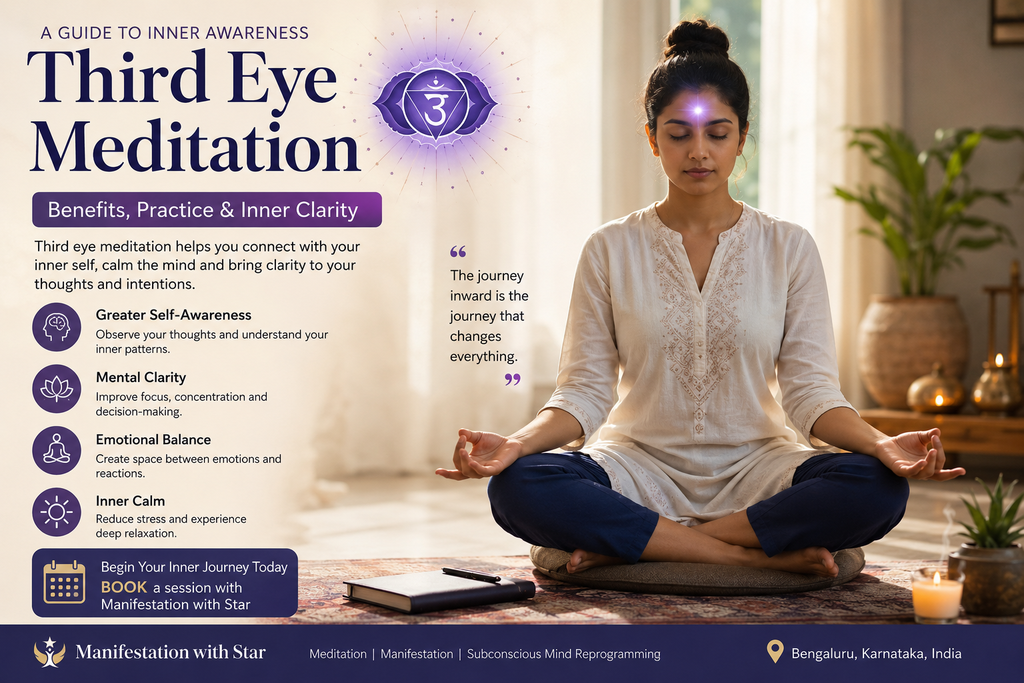
At Manifestation with Star, meditation and inner-awareness practices can be approached as opportunities to become more conscious of your thoughts, emotions and habitual patterns.
This guide explains what third eye meditation means, how you can practise it, its potential benefits, its connection with subconscious mind reprogramming, common mistakes to avoid and when professional support may be appropriate.
What Is Third Eye Meditation?
Third eye meditation is a meditation practice in which attention is gently directed towards the area traditionally associated with the third eye, located around the centre of the forehead between the eyebrows.
In many spiritual traditions, this area is associated symbolically with:
- Intuition
- Inner awareness
- Concentration
- Self-reflection
- Spiritual insight
- Mental clarity
It is important to distinguish spiritual symbolism from established medical science. The third eye is not recognised by modern medicine as a physical organ that can literally be “opened”.
Instead, the meditation can be understood as a form of focused attention and introspection.
Meditation itself involves different techniques, including focusing attention on breathing, sounds, visual images, mantras or present-moment awareness.
How Does Third Eye Meditation Work?
The basic principle is simple: bring your attention inward without forcing an experience.
Instead of trying to create visions or unusual sensations, you can sit quietly, settle your breathing and gently place your attention around the space between your eyebrows.
Your mind will naturally wander.
Thoughts about work, relationships, responsibilities and the future may appear. Rather than fighting them, acknowledge them and calmly return your attention to your meditation.
With consistent practice, the goal is not necessarily to experience something dramatic.
The deeper objective can be developing greater awareness of your own mental patterns.
A simple third eye meditation technique
You can begin with a short session.
1. Choose a quiet space
Sit somewhere comfortable where you are unlikely to be disturbed.
2. Keep your body relaxed
Sit upright without making your posture rigid. Relax your shoulders, jaw and hands.
3. Close your eyes gently
Allow your attention to move away from external distractions.
4. Observe your breathing
Take slow, natural breaths. Do not force deep breathing if it feels uncomfortable.
5. Bring attention towards the forehead
Gently notice the area between your eyebrows. You do not need to press or physically stimulate the area.
6. Observe without expectation
Thoughts, emotions or sensations may arise. Simply notice them.
7. Return to your focus
Whenever your attention wanders, gently return to the breath or forehead area.
8. End slowly
After several minutes, bring your attention back to your surroundings before opening your eyes.
Start with a manageable duration rather than forcing yourself to meditate for a long period.
Potential Benefits of Third Eye Meditation
The benefits of meditation can vary considerably from person to person. Therefore, it is better to focus on realistic outcomes rather than promising specific spiritual or psychological results.
1. Greater self-awareness
Meditation creates an opportunity to observe your thoughts instead of automatically reacting to every thought.
This can help you notice recurring patterns such as:
- Negative self-talk
- Fear-based thinking
- Constant worrying
- Emotional reactions
- Repetitive mental habits
Awareness is an important starting point for making intentional changes.
2. Improved mental clarity
A busy mind can make ordinary decisions feel unnecessarily complicated.
A consistent meditation routine may provide a quiet period in which you can step away from constant stimulation and observe what is happening internally.
Research into mindfulness-based practices suggests potential benefits for stress, anxiety and depressive symptoms, although outcomes vary and the evidence differs across meditation techniques.
3. Emotional observation
Third eye meditation can be used as an opportunity to notice emotions without immediately acting on them.
For example, instead of thinking:
“I am angry, so I must react.”
you may gradually learn to recognise:
“Anger is present right now.”
That small change in observation can create more space between an emotional trigger and your response.
4. A stronger sense of inner calm
Meditation is often used as part of relaxation and stress-management routines.
The aim is not to eliminate every difficult thought. Rather, regular practice can encourage periods of stillness and present-moment attention.
5. Deeper introspection
For people interested in spiritual growth, third eye meditation may become a structured time for self-reflection.
You can use the practice to explore questions such as:
- What thoughts repeatedly occupy my mind?
- What beliefs influence my decisions?
- Which habits no longer serve me?
- What kind of person do I want to become?
- What values do I want to live by?
Third Eye Meditation and Subconscious Mind Reprogramming
The idea of subconscious mind reprogramming is frequently discussed in manifestation and personal-development communities.
In practical terms, you can think about this as becoming more aware of deeply established patterns and intentionally developing healthier thought and behaviour patterns.
For example, someone who repeatedly thinks:
“I am not capable.”
may begin noticing how frequently that belief appears.
Meditation alone does not magically erase a belief. However, increased awareness can help a person recognise the pattern and then consciously work with it.
A broader personal-development routine might include:
Awareness → Reflection → Intentional thought → Repeated behaviour → Reinforcement
This is a more grounded way to approach subconscious work than expecting one meditation session to permanently change your life.
Third Eye Meditation vs Regular Mindfulness Meditation
These practices can overlap, but their emphasis is different.
| Third Eye Meditation | Mindfulness Meditation |
|---|---|
| Often focuses attention around the forehead/third-eye area | Often focuses on present-moment awareness |
| Commonly associated with spiritual traditions | Widely used in secular wellbeing programmes |
| May emphasise intuition and inner awareness | Often emphasises non-judgemental observation |
| Can include visualisation or mantra practices | Frequently uses breath, body sensations, or thoughts |
| Spiritual interpretations vary | Research evidence is broader for mindfulness-based approaches |
Neither approach needs to be treated as a competition.
The most suitable practice is often the one you can follow consistently and comfortably.
Common Mistakes During Third Eye Meditation
Trying too hard to “open” the third eye
One of the most common mistakes is expecting an immediate mystical experience.
Meditation is not a performance.
If you constantly ask yourself, “Am I seeing something yet?”, you may create unnecessary tension.
Forcing concentration
Your mind will wander. That is normal.
Instead of becoming frustrated, simply return your attention to your chosen focus.
Expecting meditation to cure depression
This is particularly important.
Meditation may complement emotional wellbeing, but it should not be presented as a cure for depression. Research suggests mindfulness-based approaches may support people experiencing depression and anxiety, but meditation should not replace appropriate professional care.
Practising without listening to your body
If a technique causes significant discomfort, anxiety or distress, stop and reassess your practice.
Meditation is generally considered to have relatively few risks, but negative experiences can occur for some people.
Practical Tips for Better Meditation
A peaceful meditation routine does not require an elaborate setup.
Create consistency
Practising regularly is generally more useful than occasionally attempting very long sessions.
Keep expectations realistic
You may experience calmness one day and restlessness the next.
Both experiences are normal.
Combine meditation with healthy habits
Meditation works best as part of a broader approach to wellbeing that may include adequate sleep, physical activity, social connection, balanced nutrition and appropriate professional support.
Keep a reflection journal
After meditation, write down a few observations:
- How did I feel before practising?
- What thoughts appeared repeatedly?
- What emotions did I notice?
- What did I learn about myself?
Over time, these observations may reveal patterns that are difficult to notice during everyday life.
Learn with appropriate guidance
If you are new to meditation or prefer structured instruction, guided sessions can help you understand posture, breathing, attention and pacing.
Manifestation with Star can be considered by individuals in Bengaluru, Karnataka, India, who are looking for guided approaches to meditation and manifestation-oriented inner work.
Who Can Consider Third Eye Meditation?
Third eye meditation may appeal to people who want to explore:
- Self-awareness
- Meditation
- Personal reflection
- Spiritual practices
- Mental clarity
- Mindfulness
- Inner growth
- Positive thought patterns
It is not necessary to follow a particular belief system to practise quiet, focused meditation.
However, expectations should remain realistic.
Meditation is a practice—not a substitute for medical or psychological treatment.
When Should You Seek Professional Support?
If you are experiencing persistent sadness, hopelessness, severe anxiety, inability to function normally, thoughts of self-harm or other serious mental-health symptoms, meditation should not be your only form of support.
Speak with a qualified mental-health professional or healthcare provider.
If meditation makes you feel significantly distressed, disoriented or overwhelmed, pause the practice and seek appropriate guidance.
NCCIH specifically advises people not to use meditation as a reason to postpone conventional medical care.
For someone dealing with depression, meditation can potentially be one supportive wellbeing practice, rather than the entire treatment plan.
How to Build a Simple Third Eye Meditation Routine
You can use a simple weekly structure:
| Stage | Practice |
|---|---|
| Beginning | 5 minutes of quiet breathing |
| Developing | Add gentle attention to the forehead area |
| Reflecting | Spend 2–3 minutes observing thoughts |
| Journaling | Write down one important observation |
| Progressing | Gradually develop a consistent routine |
There is no need to rush.
The purpose is to develop familiarity with stillness and awareness rather than chase unusual experiences.
How Manifestation Fits Into the Practice
Manifestation practices often focus on intention, beliefs, visualisation and purposeful action.
Meditation can create a quieter mental environment in which you examine those intentions more carefully.
For example, instead of simply saying:
“I want a better life.”
you can reflect on:
What does a better life actually mean to me?
Then ask:
- What belief is holding me back?
- What behaviour needs to change?
- What action can I take today?
- Is my intention realistic and meaningful?
This makes manifestation more action-oriented and reflective.
At Manifestation with Star, individuals interested in this area can explore guided practices that connect meditation, self-awareness and intentional personal development.
FAQ section
1. What is third eye meditation?
Third eye meditation is a contemplative practice that commonly involves directing gentle attention towards the area between the eyebrows. It is traditionally associated with intuition and inner awareness. From a practical perspective, it can also be approached as focused attention and self-reflection rather than as a guaranteed supernatural experience.
2. What are the benefits of third eye meditation?
Potential benefits depend on the individual and the meditation technique. Meditation may support relaxation, self-awareness, attention and emotional observation. Research on mindfulness-based practices suggests potential benefits for stress, anxiety and depressive symptoms, although meditation should not be considered a guaranteed treatment or cure.
3. Can third eye meditation help with subconscious mind reprogramming?
Meditation can encourage awareness of recurring thoughts, beliefs and emotional patterns. This awareness may support personal-development work sometimes described as subconscious mind reprogramming. However, one meditation session cannot be expected to permanently change deeply established beliefs.
4. How long should I practise third eye meditation?
Beginners can start with a short, comfortable session and gradually develop consistency. There is no universal duration that works for everyone. The quality of attention and ability to practise comfortably are more useful considerations than forcing yourself to meditate for a specific number of minutes.
5. Is third eye meditation safe?
Meditation is generally considered to have relatively few risks, but some people can experience unpleasant effects such as increased anxiety or low mood. If meditation causes significant distress, stop and seek appropriate guidance. People receiving mental-health treatment should discuss complementary practices with their healthcare provider when appropriate.
6. Can meditation cure depression?
Meditation should not be described as a cure for depression. Some mindfulness-based practices may help reduce symptoms of depression, but individual results vary. People experiencing persistent or severe symptoms should seek support from a qualified healthcare or mental-health professional rather than relying on meditation alone.
7. Can I practise third eye meditation at home?
Yes. You can practise a simple version at home in a quiet, comfortable environment. Begin with natural breathing and gentle attention rather than trying to force sensations or visual experiences. A guided session may be useful if you are unfamiliar with meditation or find it difficult to maintain focus independently.